Engineering / Infrastructure / Labs
PSLP Lab
A computing lab for probability, statistics and linear programming, where learners analyse data, test hypotheses and solve optimisation problems with professional tools.
Overview
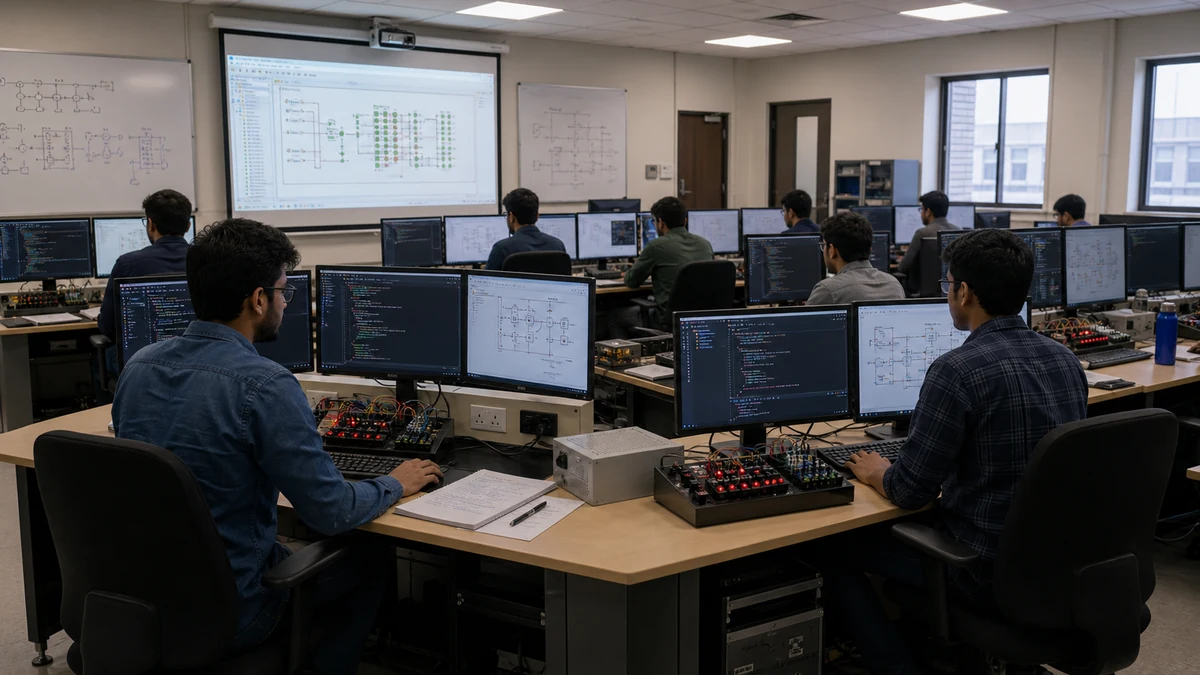
The Probability, Statistics and Linear Programming (PSLP) Lab puts statistical analysis, probabilistic modelling and optimisation into practice. Learners work with real data sets to describe and interpret variation, apply probability distributions and hypothesis tests, and formulate and solve linear-programming models.
The focus is on decision-making: turning data into evidence and constraints into an optimal plan, skills that apply in production, logistics, quality and research. ASFAN designs, supplies, installs and commissions the complete PSLP Lab, with operating manuals, experiment sheets and instructor training.
Key Equipment
- Computer workstations (25+) – set up for statistical and optimisation software
- SciLab – numerical and optimisation tasks
- R – statistical computing and graphics
- Spreadsheet software – descriptive statistics and quick analysis
- Linear-programming solvers – formulating and solving optimisation models
- Printer and projector – for reports and demonstrations
Learning Objectives
By the end of the training, learners will be able to:
- Solve practical problems with discrete and continuous probability distributions.
- Organise, summarise and interpret data with suitable statistical tools.
- Apply hypothesis tests to draw conclusions from sample data.
- Formulate linear-programming models and find optimal solutions.
Career Relevance
Analytical and optimisation skills from this lab support careers in operations, quality engineering, data analysis and research.
Related Labs
Related engineering and technology solutions
Engineering lab equipment, technology equipment, and training solutions for institutions.
Digital fabrication, CNC, robotics, 3D scanning, and prototyping equipment.
University labs, smart engineering labs, workshops, and research facilities.
Concrete 3D printer systems for labs, research, and construction technology.
Precision 3D printing for research labs, prototyping, and engineering education.
Spatial vision cameras for robotics, 3D scanning, automation, and AI labs.