Engineering / Infrastructure / Labs
Strength of Materials Lab
A materials-testing lab where learners load real specimens to failure and measure strength, hardness, toughness, fatigue and creep – the data every machine element is designed from.
Overview
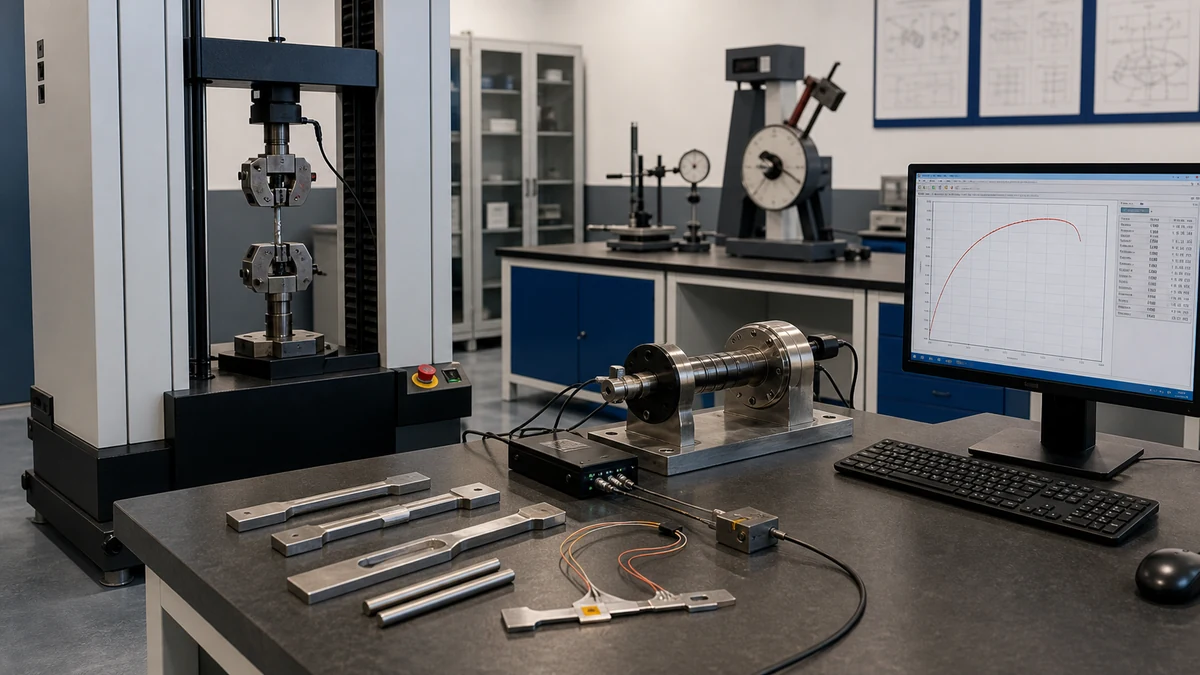
The Strength of Materials Lab gives learners direct experience of how engineering materials behave under tension, compression, shear, torsion, bending and impact. The first course concentrates on measuring the basic mechanical properties used to size machine parts; an advanced course goes further into failure mechanisms under different loading conditions.
Every machine in the lab produces measurable numbers – load, extension, angle of twist, indentation, absorbed energy – so students learn to turn raw readings into the properties that appear in design handbooks. ASFAN designs, supplies, installs and commissions the complete Strength of Materials Lab, with operating manuals, experiment sheets and instructor training.
Key Equipment
- Universal Testing Machine – tensile, compressive and shear strength of specimens
- Torsion Testing Machine – shear strength and modulus of rigidity under applied torque
- Brinell Hardness Tester – hardness of coarse-grained materials
- Rockwell Hardness Tester – hardness of fine-grained and hardened materials
- Izod and Charpy Impact Testers – impact strength and toughness of notched specimens
- Flexural Testing Machine – bending strength of beams, including concrete samples
- Column Buckling Apparatus – critical load of columns with different end conditions
- Fatigue Testing Machine – endurance strength under repeated loading
- Strain Gauge Apparatus – strain and deformation of a part under external load
- Beam Deflection Apparatus – experimental verification of beam deflection theory and Maxwell's reciprocal theorem
- Creep Apparatus – deformation of a material over time under constant stress
Learning Objectives
By the end of the training, learners will be able to:
- Describe how materials behave and fail under tension, compression, torsion and bending.
- Measure impact resistance, endurance strength and shear strength.
- Compare hardness test methods and interpret their results.
- Verify Maxwell's reciprocal theorem and the effect of end conditions on column buckling.
- Explain how strain gauges work and how materials creep under sustained load.
- Calculate mechanical properties and the flexural strength of structural members such as concrete beams.
Career Relevance
Testing skills of this kind are the basis of careers in product design, quality assurance, materials engineering and manufacturing.
Related Labs
Related engineering and technology solutions
Engineering lab equipment, technology equipment, and training solutions for institutions.
Digital fabrication, CNC, robotics, 3D scanning, and prototyping equipment.
University labs, smart engineering labs, workshops, and research facilities.
Concrete 3D printer systems for labs, research, and construction technology.
Precision 3D printing for research labs, prototyping, and engineering education.
Spatial vision cameras for robotics, 3D scanning, automation, and AI labs.