Skip to content

Laboratory & Life Science Equipment

Analytical Laboratory Instruments

Instruments that identify and quantify residues, elements, compounds and antibodies in food, soil, water, plant and biological samples.

Analytical Laboratory Instruments

Accurate answers from complex samples

Analytical instruments provide the confirmatory measurements behind food safety, environmental and agricultural decisions. Gas chromatographs with FID, TCD, ECD and FPD detectors separate and quantify volatile compounds and pesticide residues, atomic absorption spectrometers measure metals at trace levels by flame or graphite furnace, UV-Vis spectrophotometers support a wide range of colorimetric methods, microplate readers run ELISA tests for toxins, hormones and diseases, and flame photometers determine potassium, sodium and lithium. Viscometers characterise oils, syrups and solutions. University, government, food and quality-control laboratories use them daily. ASFAN supplies, installs and supports analytical instruments and helps specify complete laboratories.

ASFAN supplies, installs and supports analytical instruments for university, government and food laboratories across Saudi Arabia.

Analytical Instruments

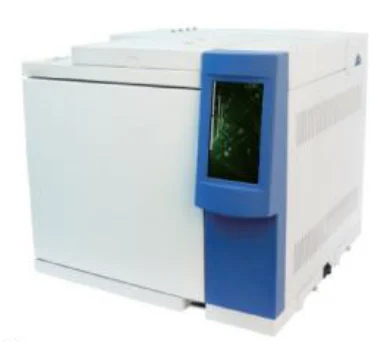
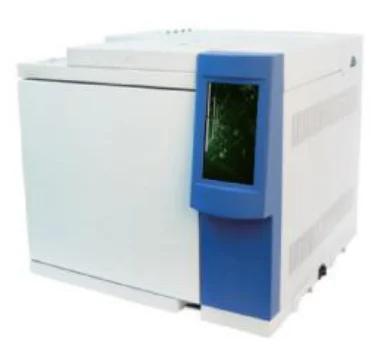
Gas Chromatograph (FID / TCD)

Gas Chromatograph (FID / TCD)

Gas chromatograph for qualitative and quantitative analysis of multi-component mixtures, used in medicine and health, petrochemicals, environmental monitoring and biochemistry. It combines PC software with a 7-inch touch screen and supports automatic samplers.

  • Column oven22 L, 5–400 ℃ above room temperature, ±0.1 ℃
  • Heating rate0.1–60 ℃/min, 9-step programming
  • Cooling speed≤ 10 min (250 ℃ → 50 ℃)
  • Injector7–420 ℃; up to 3 injectors; packed column, split
Features & full specifications

Key features

  • PC control software with built-in chromatography workstation; two-way control with touch screen
  • 7-inch color touch screen with digital carrier/hydrogen/air flow display
  • Gas shortage alarm; heating shuts down when the column oven door opens
  • Automatic split flow / split ratio control saves carrier gas
  • Automatic sampler interface
  • 32-bit multi-core embedded hardware
  • One-button start with 20 stored methods
  • 8 external event outputs; RS232 and LAN ports

Technical specifications

Column oven22 L, 5–400 ℃ above room temperature, ±0.1 ℃
Heating rate0.1–60 ℃/min, 9-step programming
Cooling speed≤ 10 min (250 ℃ → 50 ℃)
Injector7–420 ℃; up to 3 injectors; packed column, split
Carrier pressure range0–400 kPa, 0.1 kPa accuracy
DetectorsFID, TCD optional (max. 2), max. 420 ℃
FID detection limit≤ 3×10⁻¹² g/s (n-hexadecane)
TCD sensitivity5000 mV·mL/mg (n-cetane)
Power supplyAC220V±22V, 50Hz±0.5Hz; 3000 W
Request a quote
Gas Chromatograph (FID / TCD / ECD / FPD)

Gas Chromatograph (FID / TCD / ECD / FPD)

Gas chromatograph for qualitative and quantitative analysis of complex mixtures in medicine and health, petrochemicals, environmental monitoring and biochemistry. Up to two detectors can be fitted from FID, TCD, ECD and FPD, with six independent heating zones.

  • Column oven5–400 ℃ above room temperature, ±0.1 ℃
  • Program heating9/10 stages, max. 60 ℃/min, total 9999.9 min
  • Sampler7–420 ℃; up to 3 sampling systems; constant pressure
  • DetectorsUp to 2 of FID, TCD, ECD, FPD; max. 420 ℃
Features & full specifications

Key features

  • 7-inch color touch screen; synchronous control from computer and host
  • 32-bit multi-core embedded hardware
  • Digital display of carrier, hydrogen and air flow (pressure)
  • Gas shortage alarm and oven-door heating protection
  • Automatic split flow / split ratio control
  • Dual-channel data acquisition card, 50 ms sampling
  • Automatic sampler interface; 8 external event outputs
  • RJ45 network connection for remote control

Technical specifications

Column oven5–400 ℃ above room temperature, ±0.1 ℃
Program heating9/10 stages, max. 60 ℃/min, total 9999.9 min
Sampler7–420 ℃; up to 3 sampling systems; constant pressure
DetectorsUp to 2 of FID, TCD, ECD, FPD; max. 420 ℃
FIDDetection limit ≤ 3×10⁻¹² g/s; dynamic range 10^7
TCD5000 mV·mL/mg; bridge current 0–220 mA
ECDNi63 source; detection limit ≤ 8×10⁻¹⁴ g/s
FPDMax. 350 ℃; detection limit ≤ 2×10⁻¹² g/s (P), ≤ 4×10⁻¹¹ g/s (S)
Heating zones6 (2 injector, 2 detector, 2 auxiliary up to 400 ℃) plus column oven
Request a quote
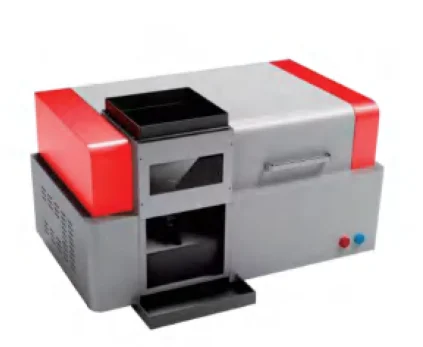
Atomic Absorption Spectrometer (Flame)

Atomic Absorption Spectrometer (Flame)

Eight-lamp atomic absorption spectrometer for scientific research, quality inspection, disease control, environmental protection, metallurgy, agriculture, forestry and chemical industries. Fully automatic flame analysis with automatic wavelength scanning and lamp alignment.

  • Wavelength range185–900 nm
  • MonochromatorCzerny–Turner, 1800 lines/mm grating, 230 nm blaze
  • Spectral bandwidth0.1/0.2/0.4/0.7/1.0/1.4/2.0 nm, automatic switching
  • Wavelength accuracy / repeatability±0.15 nm / < 0.10 nm
Features & full specifications

Key features

  • 8-lamp automatic turret with independent lamp power supplies and pre-heating
  • 1800 lines/mm grating, self-collimating monochromator, quartz-coated optics
  • Corrosion-resistant polymer atomization chamber (hydrofluoric acid resistant)
  • Air-cooled premixed titanium burner, 50 mm and 100 mm
  • Automatic ignition, extinguishing and gas-flow setting
  • Deuterium lamp and self-absorption background correction
  • Safety protection on power failure, misoperation or acetylene leakage
  • Sensitivity ≤ 0.015 µg/mL/1%; baseline drift < 0.003 Abs/30 min

Technical specifications

Wavelength range185–900 nm
MonochromatorCzerny–Turner, 1800 lines/mm grating, 230 nm blaze
Spectral bandwidth0.1/0.2/0.4/0.7/1.0/1.4/2.0 nm, automatic switching
Wavelength accuracy / repeatability±0.15 nm / < 0.10 nm
ResolutionBetter than 0.3 nm
Characteristic concentration (Cu, flame)< 0.015 µg/ml/1%
Detection limit (Cu, flame)< 0.002 µg/ml
Precision (Cu)< 0.5%
Baseline stability0.002 Abs (static), 0.004 Abs (dynamic)
Deuterium background correctionMore than 60 times
Request a quote
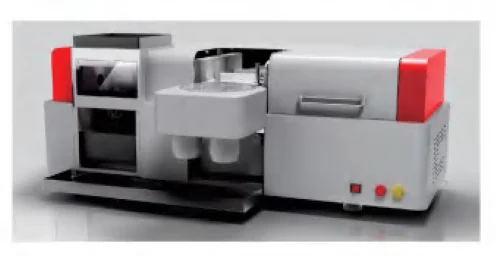
Atomic Absorption Spectrometer (Flame + Graphite Furnace)

Atomic Absorption Spectrometer (Flame + Graphite Furnace)

Eight-lamp atomic absorption spectrometer combining flame and graphite furnace atomizers with automatic switching between them, plus an integrated autosampler. Used in research, quality inspection, environmental protection, metallurgy, agriculture and chemical industries.

  • Wavelength range185–900 nm
  • MonochromatorCzerny–Turner, 1800 lines/mm grating, 230 nm blaze
  • Spectral bandwidth0.1/0.2/0.4/0.7/1.0/1.4/2.0 nm, automatic switching
  • Wavelength accuracy / repeatability±0.15 nm / < 0.10 nm
Features & full specifications

Key features

  • 8-lamp automatic turret with independent lamp power supplies and pre-heating
  • 1800 lines/mm grating, self-collimating monochromator, quartz-coated optics
  • Corrosion-resistant polymer atomization chamber (hydrofluoric acid resistant)
  • Air-cooled premixed titanium burner, 50 mm and 100 mm
  • Automatic ignition, extinguishing and gas-flow setting
  • Deuterium lamp and self-absorption background correction
  • Safety protection on power failure, misoperation or acetylene leakage
  • Graphite furnace with dual internal/external gas control, up to 3000 ℃
  • Integrated autosampler: min. 0.5 µL sample, online dilution and concentration
  • Automatic switching between flame and graphite furnace

Technical specifications

Wavelength range185–900 nm
MonochromatorCzerny–Turner, 1800 lines/mm grating, 230 nm blaze
Spectral bandwidth0.1/0.2/0.4/0.7/1.0/1.4/2.0 nm, automatic switching
Wavelength accuracy / repeatability±0.15 nm / < 0.10 nm
ResolutionBetter than 0.3 nm
Characteristic concentration (Cu, flame)< 0.015 µg/ml/1%
Graphite furnace heatingRT–3000 ℃, 3000 ℃/s
Graphite furnace Cd precision≤ 2% (autosampler), ≤ 3% (manual)
Graphite furnace Cd characteristic quantity / detection limit≤ 0.4×10⁻¹² g
Power supply220V ± 22V, 50Hz ± 1Hz, 5 kW (peak)
Request a quote
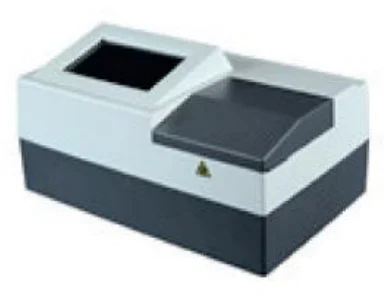
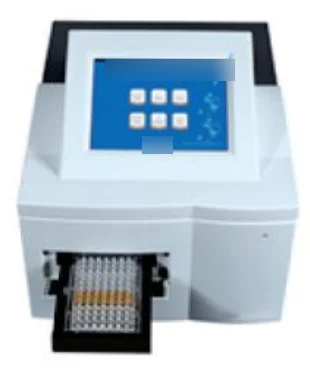
Microplate Reader (ELISA Analyzer)

Microplate Reader (ELISA Analyzer)

Microplate reader with a 7-inch color touch screen and 8-channel vertical light path for endpoint, kinetic, inhibition-rate and single/dual wavelength measurements.

  • LampDC12V 22 W tungsten halogen
  • Optical path8-channel vertical
  • Wavelength range400-1000 nm (optional 340-1100 nm)
  • Reading range0-4.000 Abs (linear 0-3.000 Abs)
Features & full specifications

Key features

  • 7-inch color LCD touch screen with visual plate display
  • Center location, accurate data, good stability and repeatability
  • Endpoint, kinetic, inhibition rate and single/dual wavelength modes
  • Wide voltage design
  • Stores 200 programs and 100,000 sample results; 10+ curve fitting equations

Technical specifications

LampDC12V 22 W tungsten halogen
Optical path8-channel vertical
Wavelength range400-1000 nm (optional 340-1100 nm)
Reading range0-4.000 Abs (linear 0-3.000 Abs)
Resolution / accuracy0.001 Abs / ≤ ±0.01 Abs
Stability / repeatability≤ ±0.003 Abs / ≤ 0.3%
Filters405, 450, 492, 630 nm standard; up to 10
Plate shaking3 linear modes, 0-255 s
PowerDC12V 5A
Size / weight400 x 260 x 200 mm; 6 kg
Request a quote
Microplate Reader with Incubation (ELISA Analyzer)

Microplate Reader with Incubation (ELISA Analyzer)

Industrial-grade microplate reader with an 8-inch color touch screen, 8-channel optical fiber measurement system and optional plate incubation; an inhibition-rate module is available for food safety and medical testing.

  • LampDC12V 22 W tungsten halogen
  • Optical path8-channel vertical
  • Wavelength range400-1000 nm (optional 340-1100 nm)
  • Reading range0-4.000 Abs (linear 0-3.000 Abs)
Features & full specifications

Key features

  • Industrial-grade color LCD touch screen
  • Eight-channel optical fiber measurement system with imported detector
  • Center positioning for accurate, reliable reading
  • Three linear plate-shaking modes
  • Open cut-off judgment formula
  • Endpoint, two-point, kinetic and single/dual wavelength modes
  • Optional inhibition-rate module for food safety and medical testing

Technical specifications

LampDC12V 22 W tungsten halogen
Optical path8-channel vertical
Wavelength range400-1000 nm (optional 340-1100 nm)
Reading range0-4.000 Abs (linear 0-3.000 Abs)
Resolution / accuracy0.001 Abs / ≤ ±0.01 Abs
Filters405, 450, 492, 630 nm standard; up to 15
IncubationRoom temp. +4 °C to 50 °C, 37 ±0.5 °C (optional)
Display8 inch color LCD touch screen
PowerAC100-240 V, 50-60 Hz
Size / weight433 x 320 x 308 mm; 11 kg
Request a quote
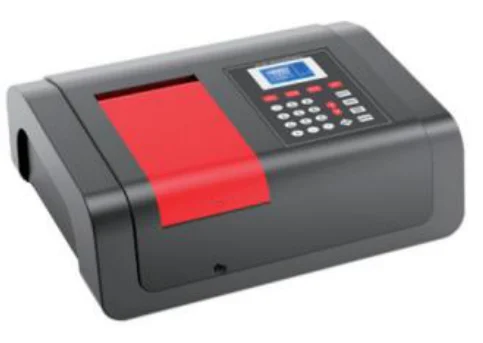
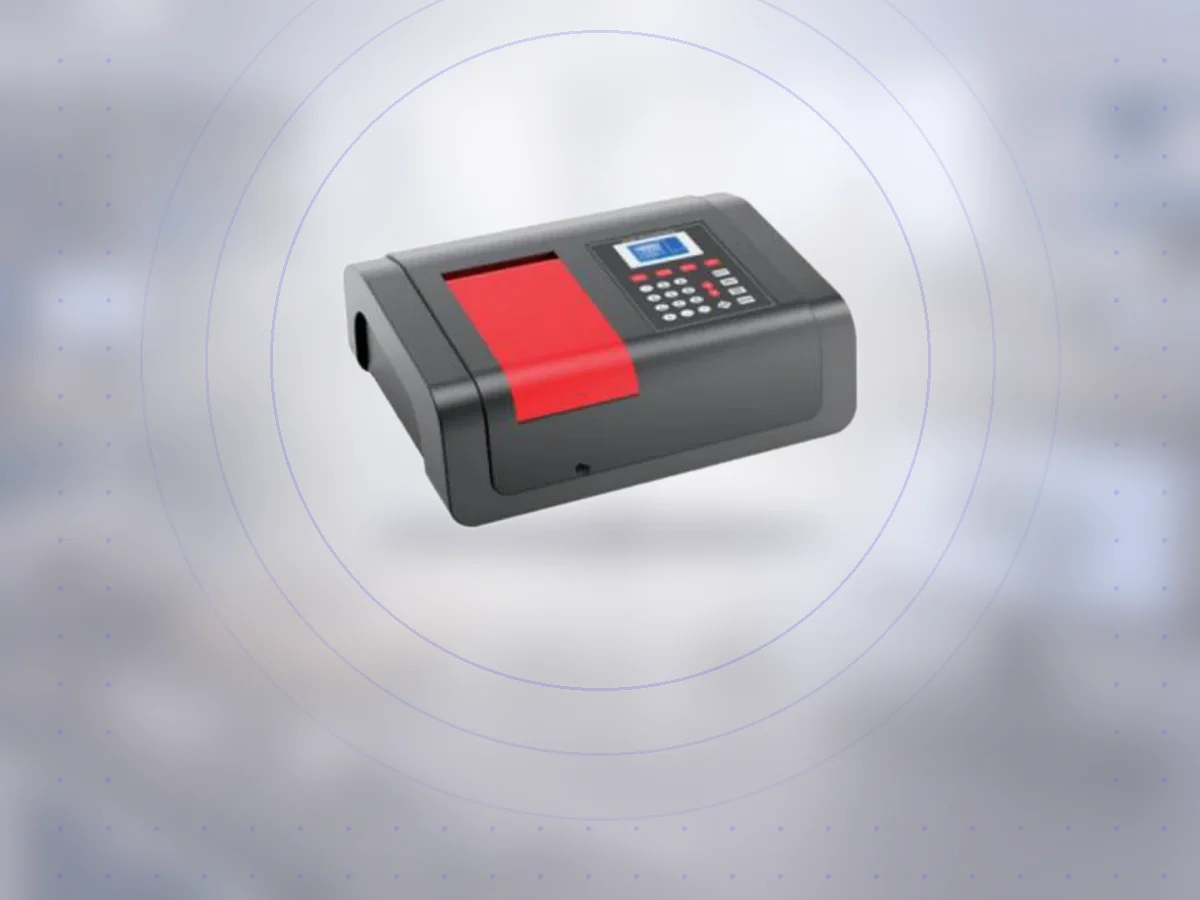
Double-Beam UV-Vis Spectrophotometer

Double-Beam UV-Vis Spectrophotometer

Microcomputer-controlled double-beam UV-Vis spectrophotometer covering 190-1100 nm, with LCD display, data/curve memory, printer and USB/PC connectivity. Software supports wavelength scans, kinetics, quantitative analysis, multi-wavelength and DNA/protein tests.

  • Wavelength range190-1100 nm
  • Bandwidth2 nm
  • Wavelength accuracy / repeatability±0.5 nm / ≤0.2 nm
  • Photometric accuracy / repeatability±0.3%T / 0.15%T
Features & full specifications

Key features

  • Single-chip microcomputer control with 128 x 64 dot LCD
  • Large memory for multiple data sets and curves
  • Auto zero / 100% adjustment and automatic wavelength setting
  • Automatic filter change; large sample compartment (5-100 mm cells)
  • Up to ten-point standard curves; direct K, B factor input
  • Parallel printer port and USB interface; PC control
  • Wavelength scan, kinetics, quantitative, multi-wavelength and DNA/protein modes

Technical specifications

Wavelength range190-1100 nm
Bandwidth2 nm
Wavelength accuracy / repeatability±0.5 nm / ≤0.2 nm
Photometric accuracy / repeatability±0.3%T / 0.15%T
Stray light≤0.05%T (220 nm NaI, 340 nm NaNO2)
Stability0.001 A/h @ 500 nm
Photometric range-0.3 to 3 A
Light sourceDeuterium lamp & tungsten halogen lamp
PowerAC 220 V/50 Hz or 110 V/60 Hz, 120 W
Dimensions / weight480 x 350 x 220 mm; 15 kg
Request a quote
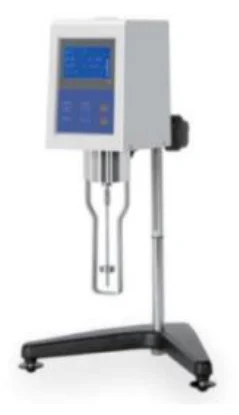
Digital Rotational Viscometer

Digital Rotational Viscometer

Digital viscometer with a blue-backlit LCD for measuring the absolute viscosity of Newtonian liquids and the apparent viscosity of non-Newtonian liquids such as paints, plastics, medicines, food, coatings, adhesives and resins. Available in three versions.

  • Measuring range1 to 1x10^5 mPa·s (high-range version: 1 to 2x10^6 mPa·s)
  • Rotors#1-4, #0 optional
  • Rotor speed6, 12, 30, 60 rpm (high-range version: 0.3-60 rpm, 8 speeds)
  • Accuracy±2% (Newtonian liquid)
Features & full specifications

Key features

  • Helical rack / helical gear lifting system
  • Universal joint at the rotor interface
  • Transmission gear of high-wear engineering plastics
  • Rotors of imported 304 stainless steel
  • Digital blue backlight LCD
  • Microcomputer control for accurate data collection

Available configurations

  • Standard version: 4 speeds, range up to 1x10^5 mPa·s
  • Version with temperature sensor
  • High-range version: 8 speeds 0.3-60 rpm, range up to 2x10^6 mPa·s

Technical specifications

Measuring range1 to 1x10^5 mPa·s (high-range version: 1 to 2x10^6 mPa·s)
Rotors#1-4, #0 optional
Rotor speed6, 12, 30, 60 rpm (high-range version: 0.3-60 rpm, 8 speeds)
Accuracy±2% (Newtonian liquid)
Repeatability±1% (Newtonian liquid)
Timer40 s - 99 min 59 s
RS232Optional
Power supplyAC220 V ±10, 50 Hz; 12 W
Working environment5-35 °C, ≤80% RH
Size / weight370 x 325 x 280 mm; 6.8 kg
Request a quote
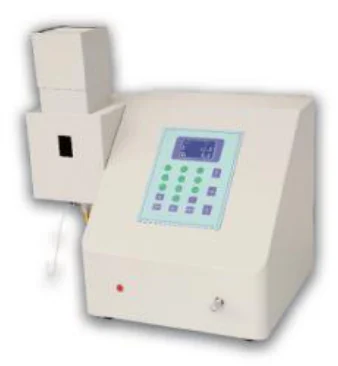
Flame Photometer (5-Element)

Flame Photometer (5-Element)

Emission-spectrum flame photometer for quantitative analysis of alkali and alkaline earth metals (K, Na, Li, Ca, Ba). Used for cement, glass and ceramics, soil fertility, pharmaceutical and food labs, clinical testing and petroleum/metallurgical/chemical products.

  • ElementsK, Na, Li, Ca, Ba
  • Measuring rangeK, Na, Li 0-100 ppm; Ca 0-1000 ppm; Ba 0-3000 ppm
  • Detection limitK 0.01, Na 0.01, Li 0.025, Ca 0.1, Ba 10 ppm
  • Repeatability≤3%
Features & full specifications

Key features

  • Measures K, Na, Li, Ca and Ba
  • Applications: cement, glass, ceramics and refractories
  • Soil fertility surveys
  • Pharmaceutical and food industry laboratories
  • Clinical testing and research
  • Petroleum, metallurgical and chemical products

Technical specifications

ElementsK, Na, Li, Ca, Ba
Measuring rangeK, Na, Li 0-100 ppm; Ca 0-1000 ppm; Ba 0-3000 ppm
Detection limitK 0.01, Na 0.01, Li 0.025, Ca 0.1, Ba 10 ppm
Repeatability≤3%
Response time< 8 s
Sample suction< 6 ml/min
Stability≤3% within 15 s (continuous injection)
Size520 x 350 x 480 mm
Net weight12 kg
Request a quote
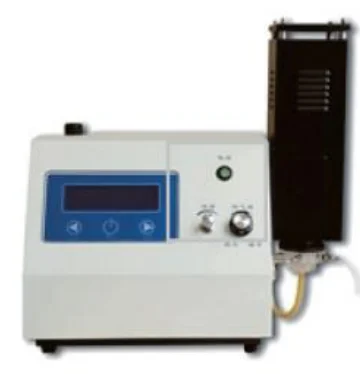
Digital Flame Photometer (K / Na / Li)

Digital Flame Photometer (K / Na / Li)

Digital flame photometer for potassium, sodium and lithium determination using LPG fuel.

  • RangeK, Na, Li: 0-999.9
  • SensitivityK 0.2 µg/mL; Na 0.2 µg/mL
  • LinearityK 0.2 µg/mL; Na 0.7 µg/mL
  • Drift< 3% within 15 s
Features & full specifications

Key features

  • Measures K, Na and Li
  • LPG fuel supply
  • Low aspiration rate (<6 mL/min)

Technical specifications

RangeK, Na, Li: 0-999.9
SensitivityK 0.2 µg/mL; Na 0.2 µg/mL
LinearityK 0.2 µg/mL; Na 0.7 µg/mL
Drift< 3% within 15 s
Reproducibility3%
Aspiration rate< 6 mL/min
FuelLPG
Shipping dimensions810 x 610 x 430 mm
Weight18 kg net / 23 kg gross
Request a quote
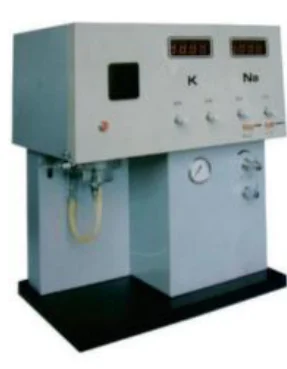
Dual-Channel Flame Photometer (K / Na)

Dual-Channel Flame Photometer (K / Na)

Flame photometer with double-channel digital indication for K and Na, widely used in clinical examination, fertilizer and soil analysis, the chemical industry, and lithium analysis. Concentration is read against a standard curve prepared from standard solutions.

  • DetectorPhotocell
  • FilterInterference filter
  • IndicationDouble-channel digital
  • Sensitivity (clinical)K 0.0-9.9 mmol/L; Na 0-199 mmol/L
Features & full specifications

Key features

  • Fast analysis and high sensitivity with little sample consumption
  • Double-channel digital indication
  • Simplified air pipeline system and digital circuit
  • Photocell detector with interference filters
  • Suitable for agricultural and industrial K/Na measurement and Li analysis

Technical specifications

DetectorPhotocell
FilterInterference filter
IndicationDouble-channel digital
Sensitivity (clinical)K 0.0-9.9 mmol/L; Na 0-199 mmol/L
RepeatabilityCV ≤ 2%
Linear disparity≤5% (K 0.02-0.06 mmol/L, Na 1.00-1.80 mmol/L)
Operating temperature10-35 °C
Humidity≤80%
Power220 ±22 V, 50 ±0.5 Hz
Request a quote

Residue confirmation

Gas chromatography with selective detectors confirms and quantifies pesticide residues and organic contaminants that rapid tests flag, supporting regulatory decisions on food and feed.

Trace metal analysis

Atomic absorption spectrometry measures lead, cadmium, copper, zinc and other metals in soil, water, plant tissue and food at the low levels that regulations require.

Immunoassays for toxins and disease

ELISA microplate readers process many samples at once for mycotoxins, drug residues, hormones and animal or plant disease markers, using commercially available test kits.

Nutrient and element testing

Flame photometers and UV-Vis spectrophotometers determine potassium, sodium and many colorimetric parameters quickly, making them workhorses in soil, fertiliser, water and food laboratories.

Frequently Asked Questions

Which gas chromatograph configuration do we need?

FID suits most organic compounds, TCD measures permanent gases, ECD is highly sensitive to halogenated pesticides, and FPD detects sulphur and phosphorus compounds such as organophosphate pesticides. Residue laboratories typically choose the multi-detector configuration.

When is a graphite furnace needed for atomic absorption?

Flame atomic absorption covers metals at moderate concentrations. A graphite furnace is needed for trace levels, such as lead and cadmium in food or drinking water, where detection limits must be much lower.

What should be prepared before installing analytical instruments?

Plan stable bench space, a reliable and protected power supply, laboratory gases where required, exhaust for flames and furnaces, and room temperature control. ASFAN reviews these requirements with you before installation.

Specify your analytical laboratory

Tell us the analytes, matrices and detection limits you need. ASFAN will recommend suitable instruments and prepare a quotation.

Request a Quote
Chat with us on WhatsApp