
On This Page
Most plants already have a 3D model. Most plants already have a SCADA dashboard. Neither of those is an operational twin, and confusing the three is the fastest way to spend a budget on something that looks impressive in a demo and gets abandoned in month four. Plant owners and training centres in Saudi Arabia run into the same confusion.
An operational twin is a running model of a facility that produces the same numbers the real facility would produce, under conditions you choose. You can push it into a fault, run it at 40% load, age a component, or hand it to a new operator and let them make an expensive mistake for free.
This guide covers what separates a real operational twin from a visualisation, the four places simulation technology actually pays for itself, and the questions to ask any digital simulation resource before you sign.
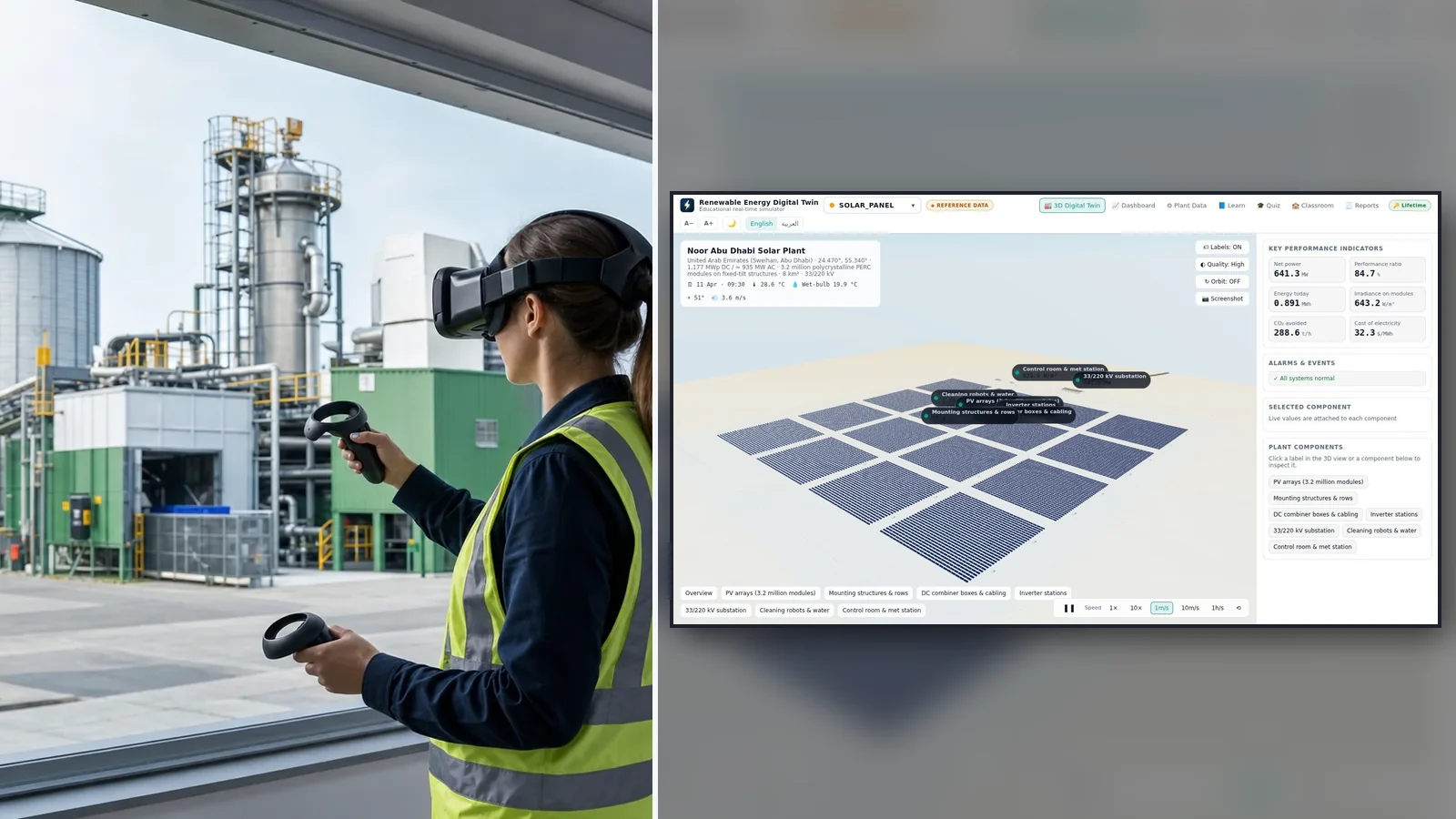
What an operational twin is, and what it isn't
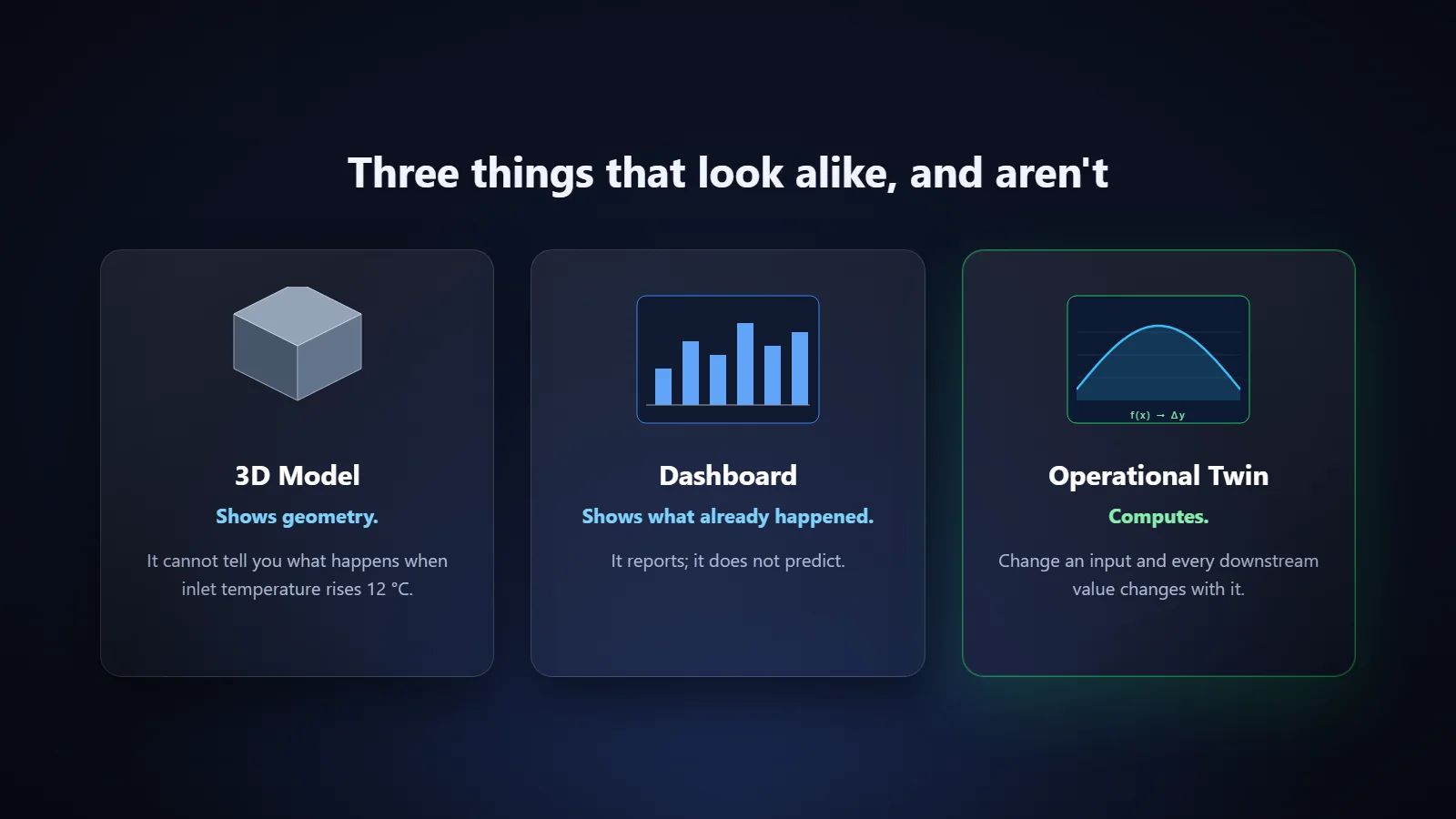
The distinction is behavioural, not visual.
- A 3D model shows you geometry. It doesn't know what happens when inlet temperature rises 12 degrees.
- A dashboard shows you what already happened. It reports; it doesn't predict.
- An operational twin computes. Change an input and every downstream value changes with it, because the values come from equations, not from a designer's idea of what looks realistic.
That last point is the whole game. A twin that displays plausible-looking numbers pulled from a lookup table is a very expensive screensaver. A twin where every displayed value traces back to a physical equation, a configured parameter, a validated performance curve, a documented stochastic model, or direct user input is a tool your engineers will actually trust.
Ask any digital twin supplier to point at a single number on screen and explain where it came from. The answer tells you everything. This traceability rule is how ASFAN builds its Renewable Energy Digital Twin and the Arab Power Digital Twin.
Where simulation technology actually pays back
Four use cases carry almost all of the return. The rest are usually optimistic slideware.
1. Operator training without operational risk
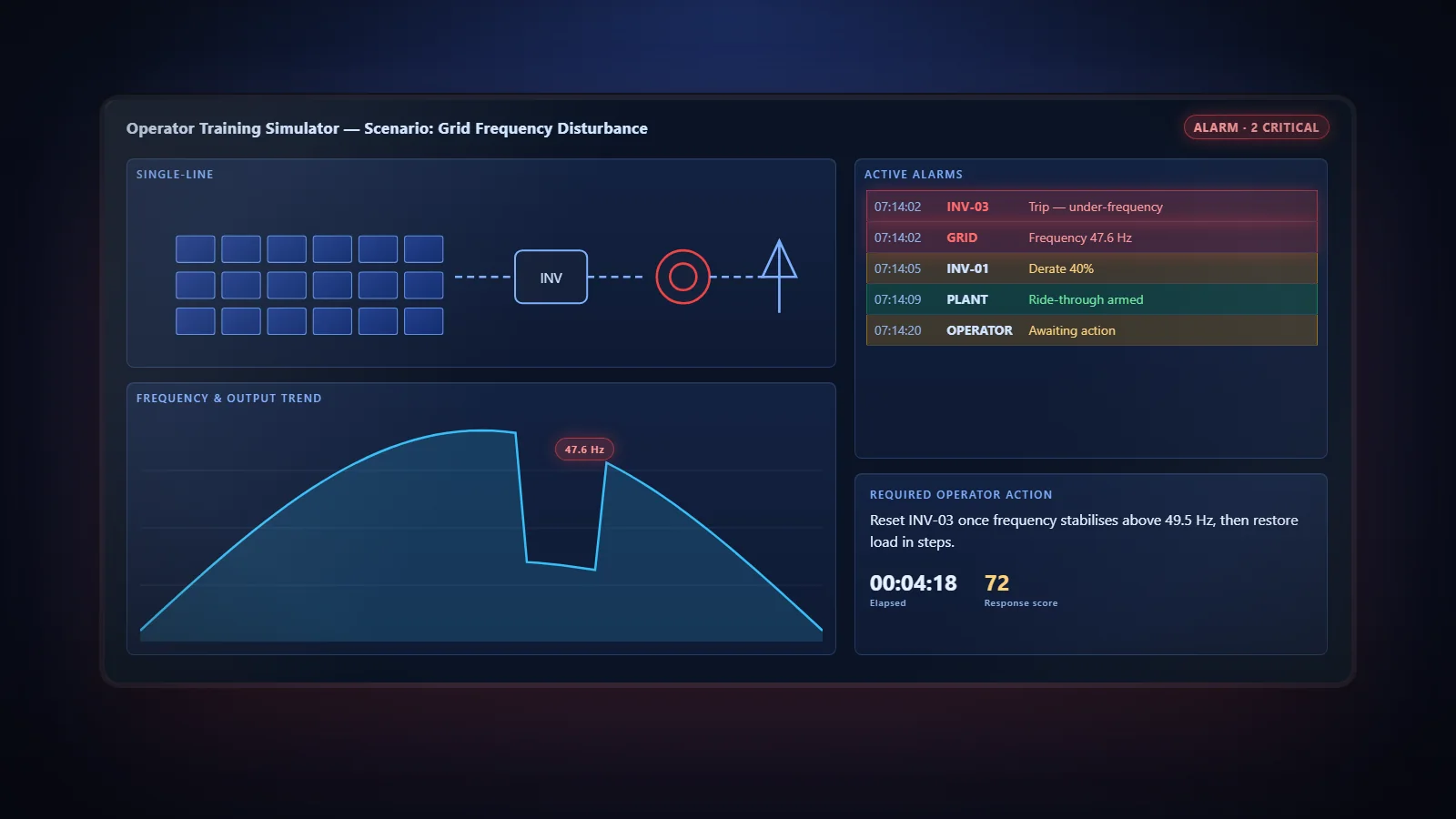
New operators learn on the real plant, which means they learn on your downtime. An operations training simulator lets them see a trip sequence, a grid disturbance, or a cascading alarm ten times before it happens once for real. Training value scales with how faithfully the twin reproduces abnormal conditions, not normal ones.
2. Design and yield estimation before capital commitment
Laying out a solar field, sizing turbines for a measured wind regime, or comparing a biomass line against a waste-to-energy line is far cheaper in software. The same engine that trains operators can size the asset, provided the underlying physics is shared rather than duplicated.
3. Compliance, biosecurity and incident rehearsal
Food and feed facilities, quarantine-sensitive sites and regulated processes all share a problem: you cannot rehearse a contamination event in production. A twin lets you run the incident-response procedure, measure the response time, and produce an auditable record of the drill. See ASFAN's biodiversity, sustainability and biosecurity solutions.
4. Stakeholder walkthroughs before anything is built
A BIM or Revit model turned into a shared VR walkthrough lets a client, a contractor and a regulator stand in the same unbuilt space at the same time. Clashes and layout objections that would surface during construction surface during design review instead. See VR for civil engineering.
How to evaluate a digital simulation resource
Treat this as a procurement checklist, not a wish list.
| Question | What a weak answer sounds like | What a strong answer sounds like |
|---|---|---|
| Where does each displayed value come from? | "It's modelled on real plant behaviour." | "Here is the equation, the parameter file, and the curve it was validated against." |
| What happens offline? | "It needs a live connection." | "It runs fully offline from a configuration file; live data is an optional layer." |
| Can we run abnormal conditions? | "The normal operating range is covered." | "Faults, derates, trips and time-based alarms are all scriptable." |
| Who owns the model? | "It's our platform." | "You own the configuration and the data; here is the export format." |
| Arabic interface? | "We can add it later." | "Bilingual from the interface layer down, including reports and units." |
| What does year two cost? | Silence. | A written figure for licences, updates and support. |
Two of those deserve emphasis for regional buyers.
Offline capability matters more than vendors admit. A twin that only works with a live plant connection is useless for design, useless for training on a plant that doesn't exist yet, and useless during the commissioning window when you need it most.
Bilingual interface is not a translation task bolted on at the end. Units, report layouts, number formatting and right-to-left layout all have to be designed in. A twin retrofitted with Arabic labels six months later will show you exactly where the shortcuts were taken.
A realistic implementation path
Buying a twin as one large deliverable tends to fail. Phasing works better.
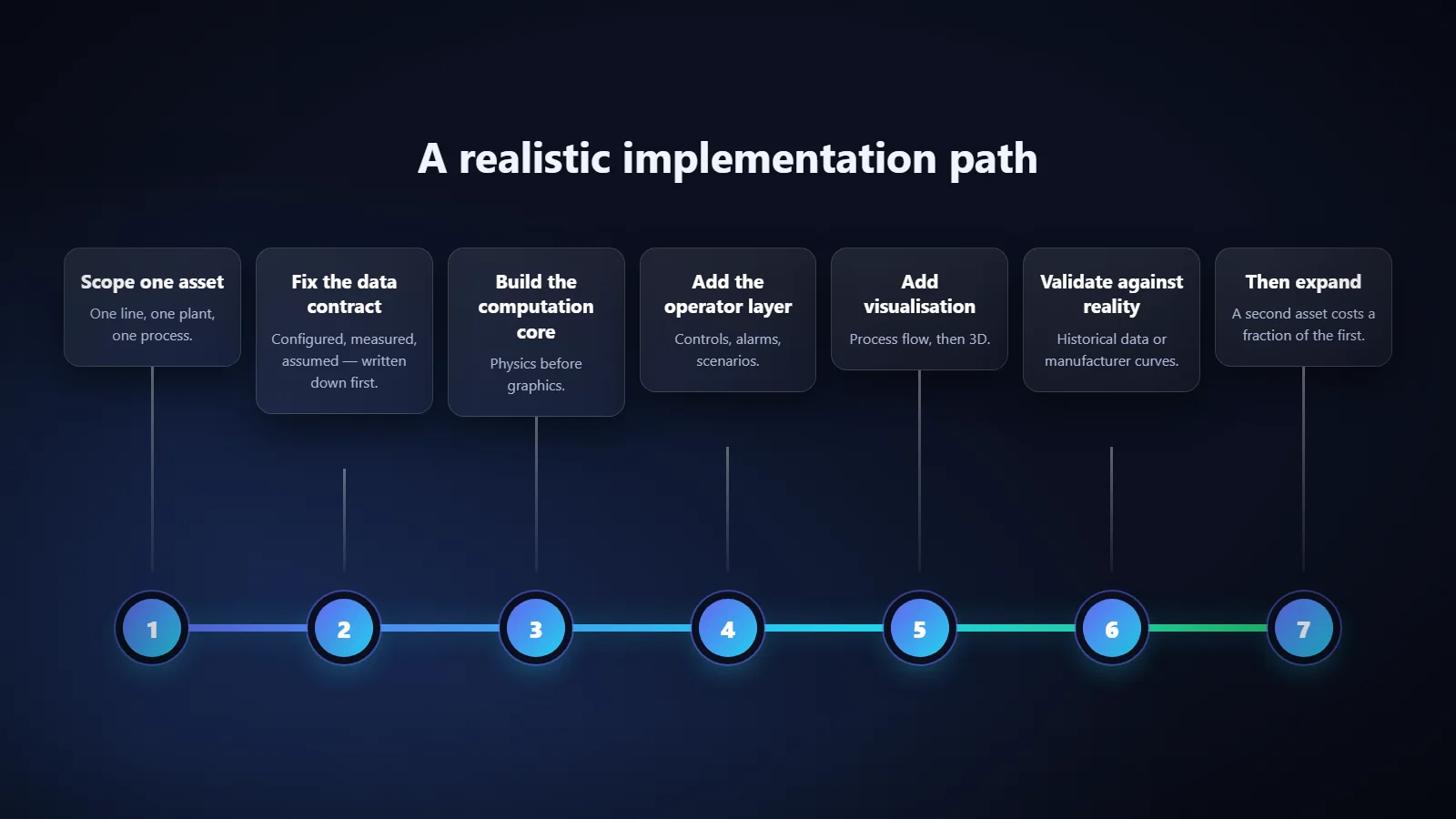
- Scope one asset, not the portfolio. One line, one plant, one process.
- Fix the data contract. Which parameters are configured, which are measured, which are assumed, written down before any code.
- Build the computation core first. Physics before graphics. A correct twin with an ugly interface is salvageable; the reverse is not.
- Add the operator-facing layer. Controls, alarms, scenarios.
- Add visualisation. Process flow, then 3D, in that order.
- Validate against something real. Historical plant data, manufacturer curves, or a commissioning test.
- Then expand. A second asset on the same core costs a fraction of the first.
Expect the first asset to take the longest and teach you the most. For terminology alignment, the ISO 23247 digital twin framework for manufacturing is a useful shared vocabulary between buyer and supplier.
What to do next
If you are evaluating operational twins, start by writing down the one decision you want the twin to improve: a training gap, a design uncertainty, a compliance drill you cannot currently run. A twin scoped against a decision gets used. A twin scoped against "digital transformation" does not.
Our guide to digital technology in education covers the same simulation technology applied to universities and training institutions.
FAQ: Operational Twins and Digital Simulation
What is the difference between a digital twin and an operational twin?
"Digital twin" is the broad category and often just means a connected data model. An operational twin specifically reproduces operating behaviour, including loads, faults, alarms and control responses, so people can operate it the way they would operate the real asset.
Does an operational twin need to be connected to a live plant?
No. A well-built twin runs entirely from configuration data, which is what makes it usable for design work, training and assets that don't exist yet. Live data integration is a layer you add later if you need it.
How do I know the numbers a simulator shows are real?
Ask for traceability. Every value should come from a documented equation, a configured parameter, a validated curve, a stated stochastic model, or direct user input. If a vendor cannot trace a number on request, assume it was invented.
How long does an operational twin take to deploy?
For a single well-scoped asset, plan in phases over several months rather than weeks. The computation core and data contract consume most of the time; visualisation is comparatively fast.
Can one simulation platform cover different energy sources?
Yes, if the engineering core is shared rather than rebuilt per technology. Geothermal, biomass, waste-to-energy, hydropower, wind and solar differ in their conversion physics but share plant-level structure, so a common core with technology-specific modules is the efficient design.
Client & Visitor Reviews
Share your experience, feedback, or opinion about this page content.
Write a Review
Latest Reviews