
VR nursing training · Module 6
Hospital-Based Electric CPR VR Nursing Simulation
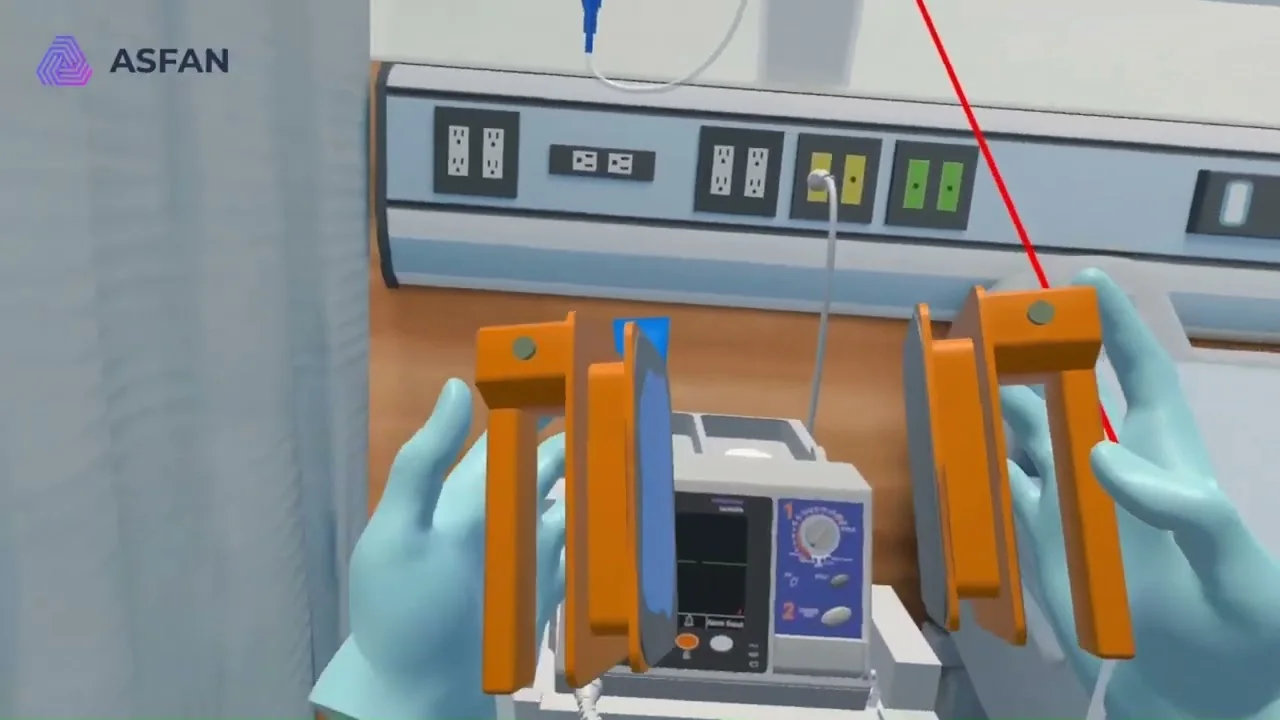
The virtual patient collapses on the ward. The learner confirms unresponsiveness and absent breathing, activates the emergency call, starts compressions at the correct depth and rate, attaches the defibrillator pads, identifies a shockable rhythm, charges the manual defibrillator, clears the team and delivers the shock, then resumes compressions and manages the airway and drugs according to the algorithm. Available for nursing schools, simulation centres and hospitals in Qatar.
In-hospital cardiac arrest demands a coordinated team response with a manual defibrillator rather than an AED. In this experience the learner leads or supports the resuscitation on a virtual ward patient: recognising arrest, calling the code, delivering high-quality compressions, applying pads, analysing the rhythm on the monitor, charging and delivering a shock safely, and continuing the algorithm until return of spontaneous circulation.
Learning objectives
By the end of this experience the learner can:
- Recognise cardiac arrest and activate the hospital emergency response.
- Deliver compressions at 100 to 120 per minute and 5 to 6 cm depth with minimal interruption.
- Operate a manual defibrillator safely: pad placement, rhythm recognition, charging, clearing and shock delivery.
- Coordinate team roles, airway management and medication timing.
Project Video
Watch the Hospital-Based Electric CPR experience recorded inside the ASFAN VR nursing simulator.
Procedure steps
- Check response and breathing and call the resuscitation team.
- Start chest compressions and request the defibrillator.
- Apply pads, pause briefly to analyse the rhythm.
- Charge, clear the patient, deliver the shock and resume compressions immediately.
- Reassess every two minutes, give adrenaline as indicated and hand over after ROSC.
Assessment
Compression quality, hands-off time, shock safety and adherence to the algorithm are measured in real time and reported.
Equipment and setting
Standalone VR headset with hand controllers, full-scale virtual patient and equipment, instructor screen mirroring, Arabic and English interface, offline operation on the campus network.
Frequently asked
Hospital-Based Electric CPR FAQ
What educators ask about this scenario.
Explore More Projects

All VR Nursing Modules
Jump directly to any of the 11 nursing modules and their 54 scenario pages.
- Nursing
- VR Peripheral IV Training
- VR Anthropometric Measurements Training
- VR Administering Injections Training
- VR Measuring Vital Signs Training
- VR Blood Transfusion Training
- VR Hospital-Based Electric CPR Training
- VR Portable CPR / AED Training
- VR Infusion Pump Training
- VR Ventilation Training
- VR Allergy Training
- VR First Aid: Bleeding Control Training
We welcome your questions, do not hesitate to contact us
- Create virtual reality and augmented reality experiences at the best prices
- Equipping engineering laboratories with the best equipment
- Virtual tours with 360° technology and also feature that you can see them through just one link
- Create virtual reality and augmented reality experiences at the best prices
- Equipping engineering laboratories with the best equipment
-
Virtual tours with 360° technology and also feature that you can see
them through just one link