
On This Page
A solar panel's nameplate rating is measured at 25 °C under a clean sky. A desert PV plant almost never sees that. Heat lowers cell efficiency, dust builds up on the glass, inverters clip at midday and rows shade each other in the morning. Digital twin solar panel simulation software turns each of those losses into a number students can watch and change.
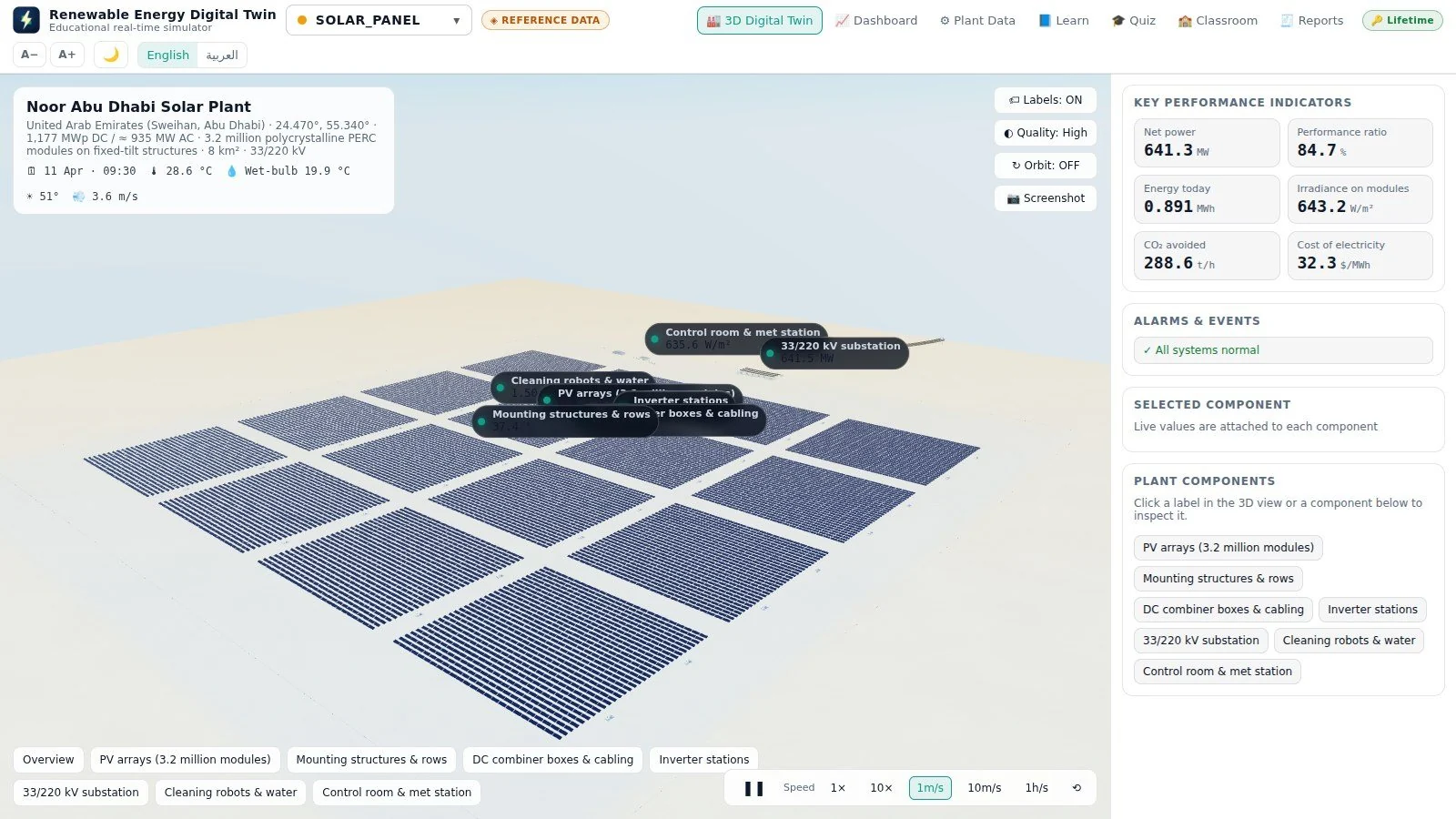
The ASFAN Renewable Energy Digital Twin rebuilds the Noor Abu Dhabi Solar Plant in the UAE, the world's largest single-site PV plant when it opened, as a live 3D model. The sun's position, the irradiance on the modules, the cell temperature and the soiling are calculated, and the performance ratio follows from them. This guide is written for universities, technical colleges and training centres in Qatar.
Download the software, brochure and user manual
The Renewable Energy Digital Twin runs on Windows 10 and 11. The trial needs no key, no payment details and no account.
The user manual is also available in Arabic.
What the solar panel digital twin simulates
The reference plant is the Noor Abu Dhabi Solar Plant in United Arab Emirates. Its figures come from the operator’s published data and are shown on the plant data sheet inside the program.
| Operator | Sweihan PV Power Company (EWEC, Marubeni, JinkoSolar) |
|---|---|
| Commissioned | 2019, the world's largest single-site PV plant at the time |
| Capacity | 1,177 MWp DC / ≈ 935 MW AC |
| Technology | 3.2 million polycrystalline PERC modules on fixed-tilt structures over 8 km², 33/220 kV |
The twin follows the sun: global, direct and diffuse irradiance, the plane-of-array irradiance for fixed or tracking structures with row shading, the cell temperature and its effect on efficiency, soiling in the desert and the night-time cleaning robots, inverter loading and clipping, performance ratio, specific yield, levelised cost of electricity and avoided CO₂.
Live values on the dashboard
The dashboard shows gauges with limit marks, trend charts over one hour, 24 hours or 31 days, a Sankey energy-flow diagram and the live alarm list. For this plant the main gauges are:
- Net power to grid
- Plane-of-array irradiance
- Cell temperature
- Soiling loss
- Performance ratio
- 7-day capacity factor
- Levelised cost of electricity
- CO₂ avoided
Scenarios to run in class
Each scenario changes the plant with one click, and every value downstream follows. Run one, let the class predict what will happen, then compare with the twin:
- Clear spring day: the reference case.
- Summer heatwave: high cell temperatures cut efficiency even under strong sun.
- Dust storm (30 % sun, heavy deposit): less light and a thick layer of dust on the modules.
- Cleaning robots down for 45 days: soiling losses build up day by day.
- Retrofit single-axis trackers: the same modules following the sun, and the extra yield it brings.
- 2030 modules (23 % bifacial TOPCon): newer, more efficient modules on the same site.
- Grid curtailment order (40 %): the grid limits what the plant can export.
Plant components you can inspect
Click a label in the 3D view, or a component in the side list, to see its live values and a short description:
- PV arrays
- Mounting structures & rows
- DC combiner boxes & cabling
- Inverter stations
- 33/220 kV substation
- Cleaning robots & water
- Control room & met station
What students learn
Each technology comes with its own Learn pages (overview, the process step by step, the key equations, the real plant data sheet, environment and a glossary) and its own quiz bank. Typical learning outcomes:
- Separate global, direct and diffuse irradiance and calculate plane-of-array irradiance.
- Relate cell temperature to module efficiency using the temperature coefficient.
- Quantify soiling losses and decide when cleaning pays for itself.
- Explain inverter clipping, performance ratio and specific yield, and compare fixed tilt with trackers.
Quizzes run in practice or timed exam mode, include questions on live data, and print certificates. With a supervisor licence, results from the whole class are collected in a shared folder, with no server needed. For hands-on equipment practice, pair the twin with ASFAN’s VR solar panel installation training.
Build your own solar panel plant
Designing a PV plant? Enter the capacity, module type, tilt or tracking and the site, and the program builds a 3D twin of your plant and runs the same solar physics on your numbers.
This twin is one of seven in the same program. See the overview of digital twin renewable energy simulation software for the other six plants.
Trial, licences and system requirements
The 14-day trial opens all seven 3D digital twins with live values, camera presets and day/night lighting, every Learn page, both interface languages and simulation speeds up to 10×. A licence unlocks the dashboard, Plant Data and scenarios, the quiz and certificates, reports and data export, the faster simulation speeds, the plant builder and Classroom mode. Licences are monthly or annual and can cover all seven technologies or only the ones you teach; supervisor licences add the Classroom results table.
- Operating system: Windows 10 or 11, 64-bit
- Memory: 4 GB minimum, 8 GB or more recommended
- Graphics: any chip with WebGL 2 (Intel HD 500 series or newer)
- Disk: 600 MB minimum, 1 GB recommended
- Internet: not required; used only for automatic updates and satellite imagery
- User rights: standard user, no administrator password
FAQ: Digital Twin Solar Panel Simulation Software
What is digital twin solar panel simulation software?
It is software that rebuilds a solar PV plant in 3D and drives it with a physics model: irradiance, cell temperature, soiling, inverter loading and performance ratio are calculated live. The ASFAN Renewable Energy Digital Twin does this for the Noor Abu Dhabi plant.
How big is the simulated solar plant?
Noor Abu Dhabi has 1,177 MWp DC (about 935 MW AC) from 3.2 million polycrystalline PERC modules on fixed-tilt structures over 8 km².
Does it model dust and panel cleaning?
Yes. Soiling in the desert and the night-time cleaning robots are part of the model, with scenarios for a dust storm and for robots out of service for 45 days.
Can I compare fixed tilt with trackers?
Yes. A scenario retrofits single-axis trackers, and another replaces the modules with 23 % bifacial TOPCon modules, so students can compare yields.
Is the solar twin in the free trial?
Yes. The 14-day trial opens Noor Abu Dhabi and the other six 3D twins with live values and every Learn page.
Client & Visitor Reviews
Share your experience, feedback, or opinion about this page content.
Write a Review
Latest Reviews