Engineering / Infrastructure / Labs
Heat and Mass Transfer Lab
Conduction, convection, radiation and heat-exchanger apparatus for measuring how heat moves through solids, fluids and space.
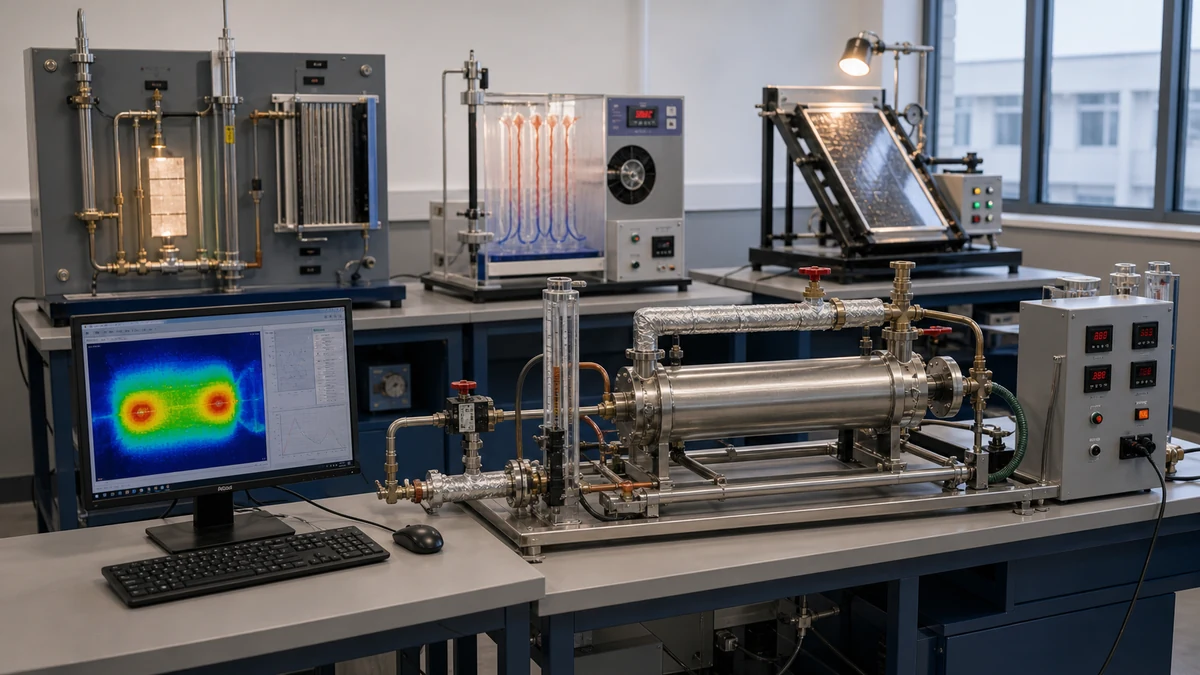
Overview
The Heat and Mass Transfer Lab gives learners practical insight into thermal conductivity, convection, radiation, heat exchangers and mass transfer. Each apparatus isolates one mechanism so students can measure it, compare it with theory and understand its practical limits.
Data acquisition on the rigs teaches accurate temperature measurement and logging – skills used every day in thermal design and testing. ASFAN designs, supplies, installs and commissions the complete Heat and Mass Transfer Lab, with operating manuals, experiment sheets and instructor training.
Key Equipment
- Thermal conductivity apparatus (metal rod, guarded hot plate, composite wall) – conduction in metals, insulators and layered walls
- Natural and forced convection apparatus – convective heat-transfer coefficients
- Pin-fin apparatus – fin efficiency and effectiveness
- Emissivity apparatus – surface emissivity
- Stefan–Boltzmann apparatus – radiation constant
- Parallel-flow and counter-flow heat exchanger – LMTD and effectiveness
- Measurement and data-acquisition system – temperature measurement and logging
Learning Objectives
By the end of the training, learners will be able to:
- Determine the thermal conductivity of a material experimentally.
- Compare heat-transfer coefficients in natural and forced convection.
- Evaluate the effectiveness of parallel-flow and counter-flow heat exchangers.
- Estimate the Stefan–Boltzmann constant from measured radiation data.
Career Relevance
Competence in heat transfer supports careers in thermal-system design, HVAC, energy management and the process industries.
Related Labs
Related engineering and technology solutions
Engineering lab equipment, technology equipment, and training solutions for institutions.
Digital fabrication, CNC, robotics, 3D scanning, and prototyping equipment.
University labs, smart engineering labs, workshops, and research facilities.
Concrete 3D printer systems for labs, research, and construction technology.
Precision 3D printing for research labs, prototyping, and engineering education.
Spatial vision cameras for robotics, 3D scanning, automation, and AI labs.