
On This Page
Biomass power is a fuel-logistics problem as much as a thermodynamics problem. A plant can have a perfect boiler and still lose output because the pellets arrived wet or the trains stopped. Digital twin biomass simulation software lets students see both halves at once.
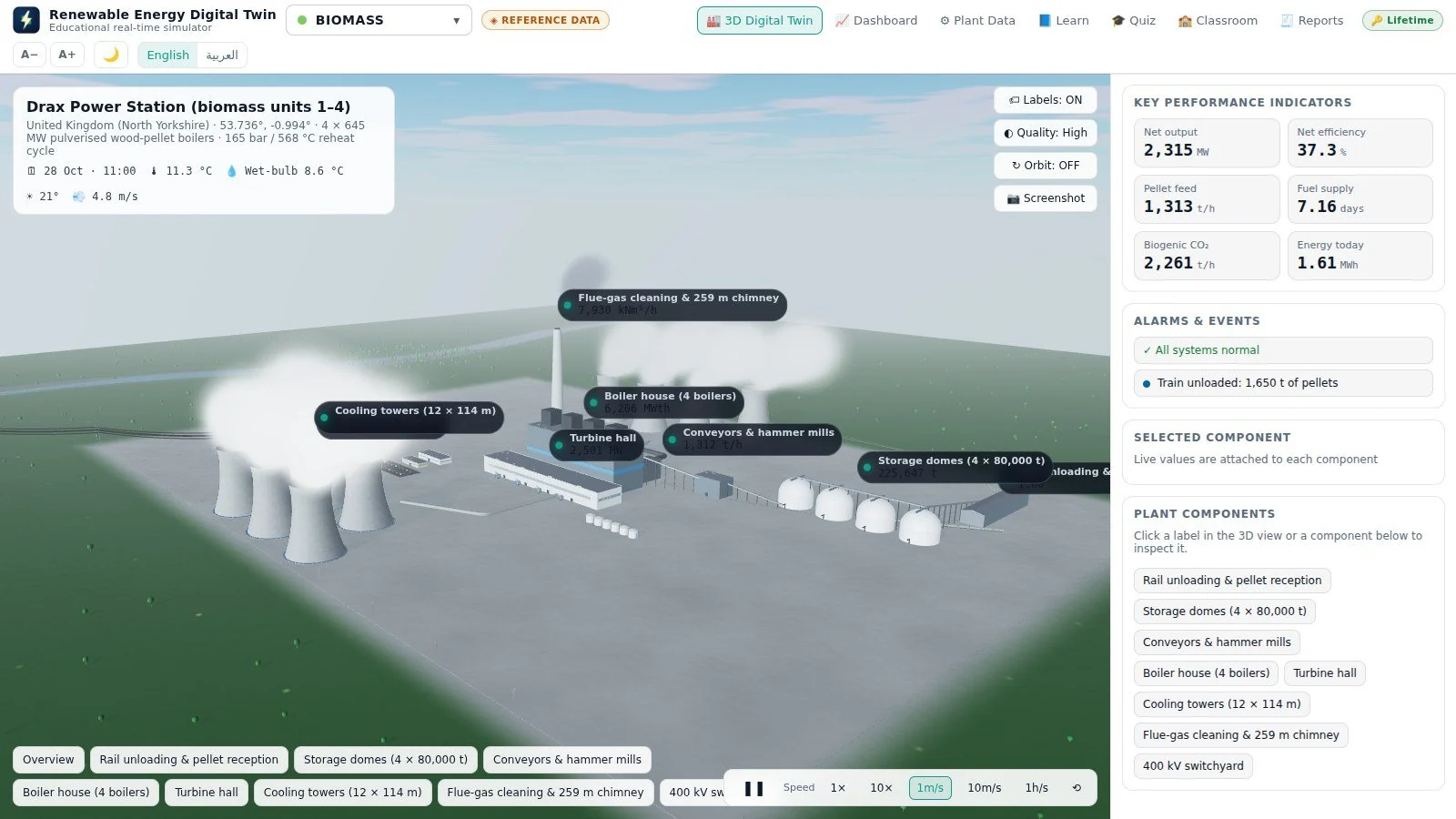
The ASFAN Renewable Energy Digital Twin rebuilds Drax Power Station in the United Kingdom, a former coal plant converted to burn wood pellets, as a live 3D model. The fuel is followed from moisture content and heating value through the boiler and the steam cycle to the grid, and every value on screen comes from the model rather than from a recording.
Download the software, brochure and user manual
The Renewable Energy Digital Twin runs on Windows 10 and 11. The trial needs no key, no payment details and no account.
The user manual is also available in Arabic.
What the biomass digital twin simulates
The reference plant is the Drax Power Station in United Kingdom. Its figures come from the operator’s published data and are shown on the plant data sheet inside the program.
| Operator | Drax Group plc |
|---|---|
| Commissioned | 1974 (coal), converted to biomass 2013 – 2018 |
| Capacity | 2,580 MW (4 × 645 MW) |
| Technology | Pulverised wood-pellet boilers, 165 bar / 568 °C reheat steam cycle |
Drax burns about 7 million tonnes of wood pellets a year, delivered by 14 trains a day into four 50 m domes that hold 80,000 t each. The twin follows the fuel from its moisture and heating value through the boiler and the Rankine cycle to the 400 kV grid, including the supply chain and the biogenic carbon accounting behind the BECCS pilot.
Live values on the dashboard
The dashboard shows gauges with limit marks, trend charts over one hour, 24 hours or 31 days, a Sankey energy-flow diagram and the live alarm list. For this plant the main gauges are:
- Net power to grid
- Pellet feed rate
- Fuel lower heating value
- Boiler efficiency
- Net plant efficiency
- Flue-gas O₂
- Condenser pressure
- Storage level
- Days of fuel supply
Scenarios to run in class
Each scenario changes the plant with one click, and every value downstream follows. Run one, let the class predict what will happen, then compare with the twin:
- Baseload operation: all four units at full output, the reference case.
- Wet fuel (30 % moisture chips): heating value drops, feed rate climbs and boiler efficiency falls; a clear lesson in why fuel quality matters.
- Port strike (4 trains a day): deliveries fall below consumption and the days-of-supply gauge starts counting down.
- Two units in outage: half the plant offline; students see output and fuel burn change together.
- Summer heatwave (+12 K): warmer cooling water raises condenser pressure and cuts cycle efficiency.
Plant components you can inspect
Click a label in the 3D view, or a component in the side list, to see its live values and a short description:
- Rail unloading & pellet reception
- Storage domes
- Conveyors & hammer mills
- Boiler house
- Turbine hall
- Cooling towers
- Flue-gas cleaning & chimney
- 400 kV switchyard
What students learn
Each technology comes with its own Learn pages (overview, the process step by step, the key equations, the real plant data sheet, environment and a glossary) and its own quiz bank. Typical learning outcomes:
- Relate fuel moisture to lower heating value and to the feed rate needed for the same output.
- Trace energy losses through the boiler, turbine and condenser on the Sankey diagram.
- Plan fuel logistics: storage, deliveries and days of supply under disruption.
- Discuss biogenic carbon accounting and what BECCS would add to a biomass plant.
Quizzes run in practice or timed exam mode, include questions on live data, and print certificates. With a supervisor licence, results from the whole class are collected in a shared folder, with no server needed. For hands-on equipment practice, pair the twin with ASFAN’s VR biomass energy training.
Build your own biomass plant
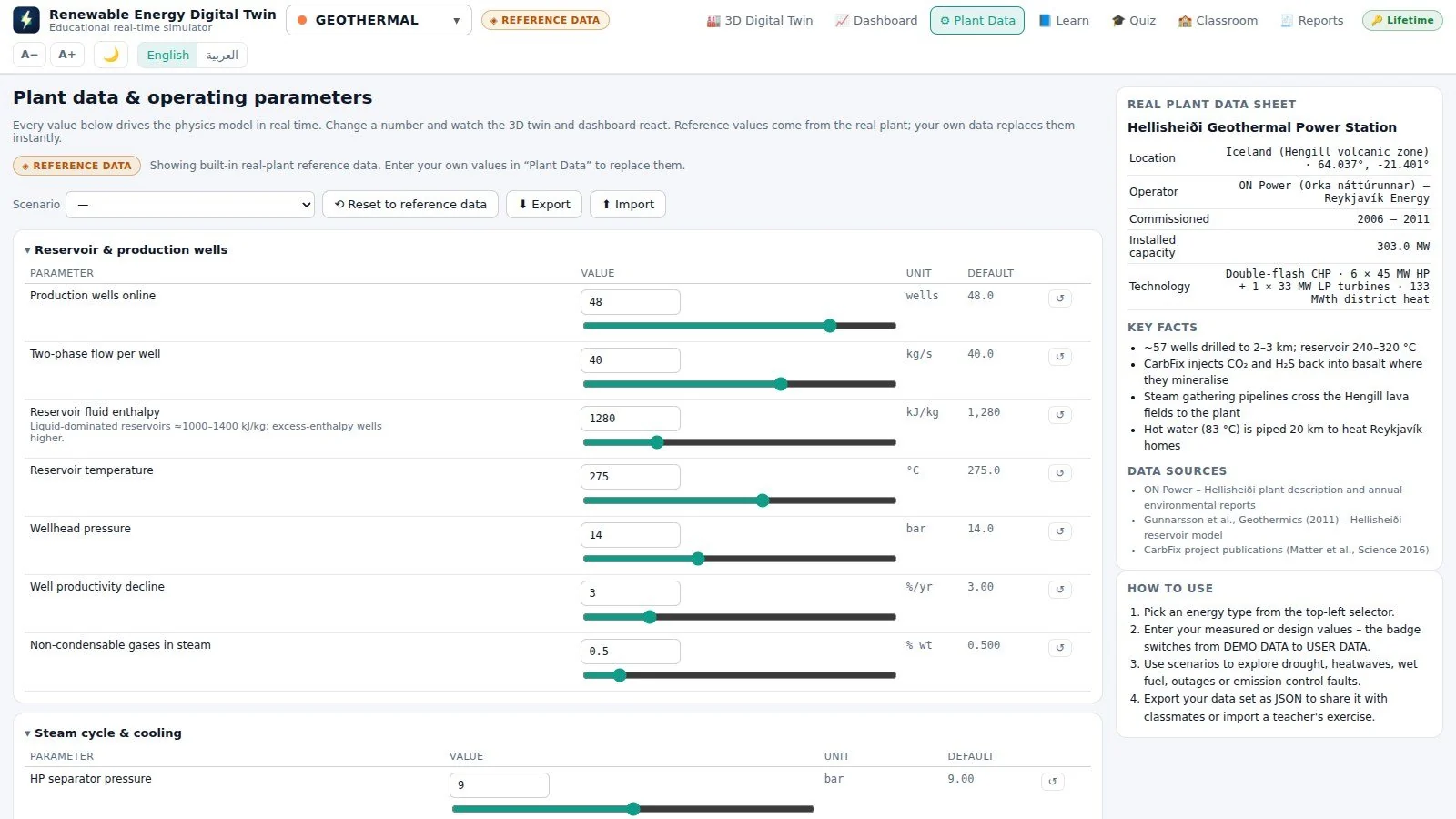
Working on a biomass project? Enter the fuel type, moisture, capacity and steam conditions of your own plant, and the program builds its 3D twin and runs the same biomass physics on your design.
This twin is one of seven in the same program. See the overview of digital twin renewable energy simulation software for the other six plants.
Trial, licences and system requirements
The 14-day trial opens all seven 3D digital twins with live values, camera presets and day/night lighting, every Learn page, both interface languages and simulation speeds up to 10×. A licence unlocks the dashboard, Plant Data and scenarios, the quiz and certificates, reports and data export, the faster simulation speeds, the plant builder and Classroom mode. Licences are monthly or annual and can cover all seven technologies or only the ones you teach; supervisor licences add the Classroom results table.
- Operating system: Windows 10 or 11, 64-bit
- Memory: 4 GB minimum, 8 GB or more recommended
- Graphics: any chip with WebGL 2 (Intel HD 500 series or newer)
- Disk: 600 MB minimum, 1 GB recommended
- Internet: not required; used only for automatic updates and satellite imagery
- User rights: standard user, no administrator password
FAQ: Digital Twin Biomass Simulation Software
What is digital twin biomass simulation software?
It is software that rebuilds a biomass power plant in 3D and drives it with a physics model, so fuel feed, boiler efficiency, steam conditions and output are calculated live. The ASFAN Renewable Energy Digital Twin does this for Drax Power Station.
Why was Drax chosen as the biomass reference plant?
Drax is one of the largest biomass power stations in the world, with 2,580 MW across four converted units, and its fuel chain (trains, domes, mills) is well documented, which makes it a strong teaching example.
Can the simulation show the effect of wet fuel?
Yes. The wet fuel scenario uses chips at 30 % moisture; the lower heating value, pellet feed rate and boiler efficiency gauges all respond.
Does the biomass twin include emissions and carbon accounting?
It includes flue-gas O₂, flue-gas cleaning and the biogenic carbon accounting behind the BECCS pilot. Values are educational estimates, not measurements from the plant.
Is there a free trial?
Yes. The 14-day trial opens the Drax twin and the other six plants with live values and every Learn page, without a key, payment or account.
Client & Visitor Reviews
Share your experience, feedback, or opinion about this page content.
Write a Review
Latest Reviews