
On This Page
Green hydrogen is a system, not a machine. The electrolysers only produce what the solar field and wind farm give them, they need ultrapure water made from the sea, and the hydrogen has to be stored and converted before it can leave the site. Digital twin green hydrogen simulation software lets students run that whole system and see where the bottlenecks are.
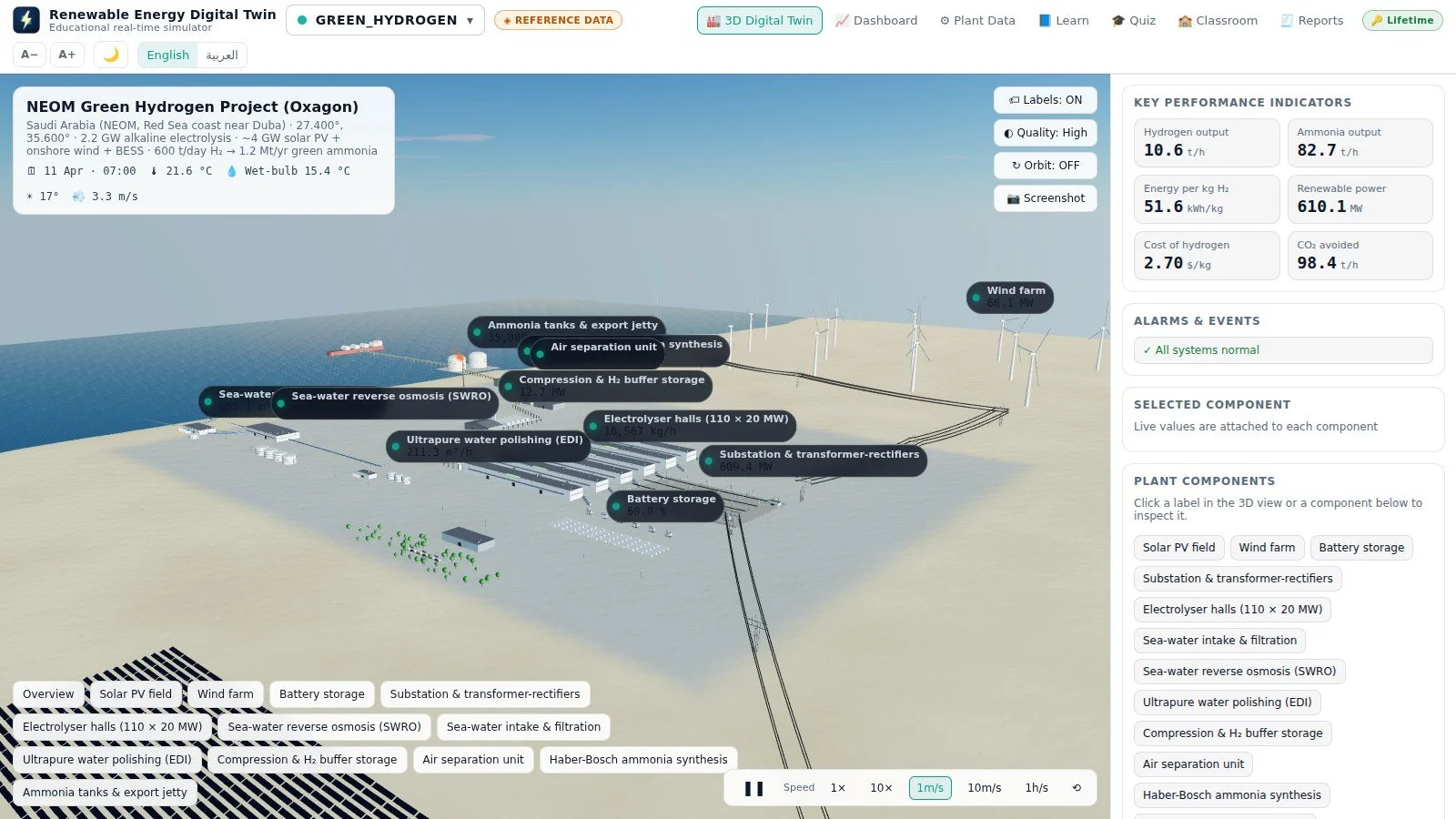
The ASFAN Renewable Energy Digital Twin rebuilds the NEOM Green Hydrogen Project in Oxagon, Saudi Arabia, from its published design data. The plant is modelled as an isolated micro-grid, so hydrogen production follows the weather, exactly the behaviour that makes green hydrogen hard to plan.
Download the software, brochure and user manual
The Renewable Energy Digital Twin runs on Windows 10 and 11. The trial needs no key, no payment details and no account.
The user manual is also available in Arabic.
What the green hydrogen digital twin simulates
The reference plant is the NEOM Green Hydrogen Project in Saudi Arabia. Its figures come from the operator’s published data and are shown on the plant data sheet inside the program.
| Operator | NEOM Green Hydrogen Company (ACWA Power, Air Products, NEOM) |
|---|---|
| Commissioning | 2026 – 2027 (design data) |
| Capacity | 2.2 GW alkaline electrolysis, 600 t H₂/day, 1.2 Mt green ammonia/year |
| Technology | ≈ 4 GW of solar PV and onshore wind with battery storage in an isolated micro-grid |
The plant is not connected to the grid: solar, wind and batteries feed the electrolysers directly, so production follows the weather. The twin covers the renewable supply, the electrolyser stacks (cell voltage, efficiency and degradation), the complete water train (sea-water intake, filtration, reverse-osmosis desalination with brine return and ultrapure polishing), hydrogen compression and buffer storage, the air separation unit, Haber-Bosch ammonia synthesis and the levelised cost of hydrogen.
Live values on the dashboard
The dashboard shows gauges with limit marks, trend charts over one hour, 24 hours or 31 days, a Sankey energy-flow diagram and the live alarm list. For this plant the main gauges are:
- Hydrogen production
- Renewable power available
- Electrolysis power
- Modules online
- Cell voltage
- Stack efficiency
- Specific energy consumption
- Ultrapure water demand
- Brine salinity
- Buffer storage level
- Ammonia production
- Battery state of charge
- Levelised cost of hydrogen
Scenarios to run in class
Each scenario changes the plant with one click, and every value downstream follows. Run one, let the class predict what will happen, then compare with the twin:
- Design operation: the reference weather and equipment state.
- Dust storm (40 % solar, weak wind): renewable supply collapses and students watch modules drop offline.
- Aged stacks (60,000 h, 2.0 V): higher cell voltage, higher specific energy use and a higher cost of hydrogen.
- Large H₂ buffer + 1 GWh battery: more storage smooths production; a direct way to discuss storage sizing.
- Grid-connected (500 MW import): what changes when the plant can draw on the grid.
- 2030 costs: the same plant with projected future equipment costs.
Plant components you can inspect
Click a label in the 3D view, or a component in the side list, to see its live values and a short description:
- Solar PV field
- Wind farm
- Battery storage
- Substation & transformer-rectifiers
- Electrolyser halls
- Sea-water intake & filtration
- Sea-water reverse osmosis
- Ultrapure water polishing (EDI)
- Compression & H₂ buffer storage
- Air separation unit
- Haber-Bosch ammonia synthesis
- Ammonia tanks & export jetty
What students learn
Each technology comes with its own Learn pages (overview, the process step by step, the key equations, the real plant data sheet, environment and a glossary) and its own quiz bank. Typical learning outcomes:
- Relate cell voltage to stack efficiency and specific energy consumption (kWh per kg of H₂).
- Explain why an off-grid electrolyser plant needs batteries and hydrogen buffer storage.
- Size the water train: how much ultrapure water per kilogram of hydrogen, and what happens to the brine.
- Break down the levelised cost of hydrogen and see how stack aging and future costs move it.
Quizzes run in practice or timed exam mode, include questions on live data, and print certificates. With a supervisor licence, results from the whole class are collected in a shared folder, with no server needed. For hands-on equipment practice, pair the twin with ASFAN’s VR green hydrogen training.
Build your own green hydrogen plant
Planning an electrolysis project? Enter the electrolyser capacity, the solar and wind supply and the storage, and the program builds a 3D twin of your plant and runs the same green hydrogen physics on your numbers.
This twin is one of seven in the same program. See the overview of digital twin renewable energy simulation software for the other six plants.
Trial, licences and system requirements
The 14-day trial opens all seven 3D digital twins with live values, camera presets and day/night lighting, every Learn page, both interface languages and simulation speeds up to 10×. A licence unlocks the dashboard, Plant Data and scenarios, the quiz and certificates, reports and data export, the faster simulation speeds, the plant builder and Classroom mode. Licences are monthly or annual and can cover all seven technologies or only the ones you teach; supervisor licences add the Classroom results table.
- Operating system: Windows 10 or 11, 64-bit
- Memory: 4 GB minimum, 8 GB or more recommended
- Graphics: any chip with WebGL 2 (Intel HD 500 series or newer)
- Disk: 600 MB minimum, 1 GB recommended
- Internet: not required; used only for automatic updates and satellite imagery
- User rights: standard user, no administrator password
FAQ: Digital Twin Green Hydrogen Simulation Software
What is digital twin green hydrogen simulation software?
It is a program that rebuilds a green hydrogen plant in 3D and drives it with a physics model: renewable supply, electrolysis, water treatment, storage and cost are calculated live. The ASFAN Renewable Energy Digital Twin does this for the NEOM Green Hydrogen Project.
Does the simulation include the electrolyser stacks?
Yes. Cell voltage, stack efficiency, degradation and specific energy consumption are modelled, and a scenario ages the stacks to 60,000 hours at 2.0 V.
Is desalination part of the hydrogen twin?
Yes. The water train covers sea-water intake, filtration, reverse osmosis with brine return and ultrapure polishing, with live gauges for water demand and brine salinity.
Does the twin calculate the cost of hydrogen?
Yes. The levelised cost of hydrogen is a live gauge, and a 2030 costs scenario shows the effect of projected equipment prices. Values are educational estimates.
Is the green hydrogen twin included in the free trial?
Yes. The 14-day trial opens NEOM and the other six 3D twins with live values and every Learn page.
Client & Visitor Reviews
Share your experience, feedback, or opinion about this page content.
Write a Review
Latest Reviews